

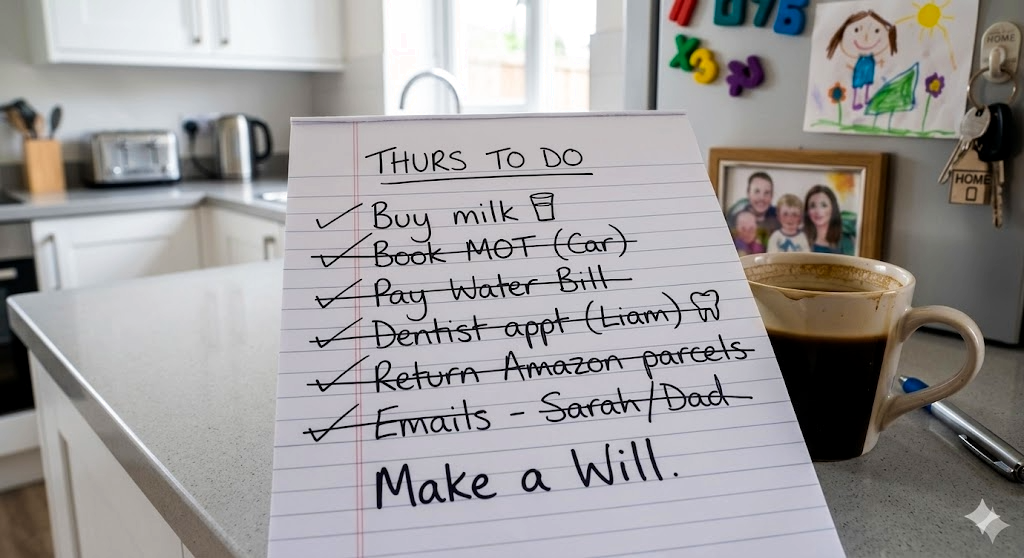
Why it shouldn’t be the last thing on your list
Dying without a Will (known as dying intestate) can create a wave of uncertainty, delays, and unintended consequences for the people you care about most. Many of us naturally assume that our property will automatically pass to our partner, or that our family will be able to divide our belongings as they see fit. In reality, the law in England and Wales follows a strict, unyielding set of intestacy rules.
These rules determine exactly who inherits and in what proportions, leaving absolutely no room for personal wishes, verbal promises, or unique family dynamics. Whether you are married, living with a partner, raising a blended family, or purchasing a home, taking the step to write a Will ensures that an already difficult time is not made far more stressful for those you leave behind. Think of a Will not just as a legal document, but as a final act of care and clarity for your family.
What Does “Intestacy” Actually Mean?
In legal terms, a person is said to have died intestate when they pass away without leaving a valid Will. This doesn’t just happen if you never write one; a Will can also be treated as legally invalid if it wasn’t signed or witnessed correctly, or if it was automatically revoked by a later marriage or civil partnership.
When intestacy occurs, the law applies a fixed, rigid bloodline hierarchy to distribute your assets. The courts cannot consider strained or estranged relationships, the actual financial needs of your family, or any wishes you might have expressed to loved ones during your lifetime. This can produce arbitrary and heartbreaking outcomes that you never would have wanted.
The Strict Order of Inheritance
If you pass away without a valid Will, the law distributes your estate based on your exact family structure at the time of your death:
If you are married or in a civil partnership AND have children:
Your estate is divided using a set legal formula:
- Your Spouse or Civil Partner receives: All of your personal belongings, a statutory legacy (fixed at £322,000 as of March 2026), and exactly half of whatever remains of your estate.
- Your Children receive: The remaining half of the estate, split completely equally among them.
If you are married or in a civil partnership with NO children:
- Your spouse or civil partner inherits everything automatically.
If you have no spouse or civil partner:
The law looks strictly down your biological family tree in this exact order of priority:
- Children or grandchildren
- Parents
- Siblings, nieces, or nephews
- Half-siblings, half-nieces, or half-nephews
- Grandparents
- Aunts, uncles, or cousins
- Half-aunts, half-uncles, or half-cousins
Protecting Your Children and Their Future
One of the most profound reasons to write a Will is to protect minor children. Under the rules of intestacy, if your children inherit a share of your estate, they do not receive it straight away. Instead, it is held in a trust managed by court-appointed trustees until they turn 18. While trustees can sometimes use these funds for the child’s advancement or benefit, a Will allows you to choose exactly who those trusted managers will be.
Even more critically, a Will is the only place where you can explicitly appoint legal guardians for your children. Without a Will, there is no automatic guardian appointment if you pass away. The decision of who raises your children is left entirely to the family to negotiate, or ultimately to the courts. Proactively naming guardians gives your children absolute certainty and shields your relatives from painful disputes during a time of immense grief.
What Happens to Your Home?
For most families, the home is their most valuable asset, and intestacy can complicate who gets to live in it. The outcome depends entirely on how the property deed is held:
- Joint Tenants: If you own the property as joint tenants, your share passes automatically to the surviving co-owner under the right of survivorship, bypassing the estate entirely.
- Tenants in Common: If you own it as tenants in common, your distinct share forms part of your estate and must be distributed according to the intestacy rules.
The Risk to Cohabiting Partners
If you live with a long-term partner but are not married or in a civil partnership, the law does not give them an automatic right to inherit your property or assets, regardless of how many years you have lived together or contributed financially. A surviving cohabiting partner may be forced to bring a lengthy, emotionally exhausting, and expensive legal claim under the Inheritance (Provision for Family and Dependants) Act 1975 just to secure the right to stay in their own home.
Shared Ownership Complexities
If a spouse and minor children survive you, intestacy can lead to a messy “shared ownership” of the family home. Because children under 18 cannot legally own property, trustees must be appointed, which can make it exceptionally difficult for the surviving spouse to sell, downsize, or remortgage the property in the future.
Who Administers Your Estate?
When you die without a Will, you leave behind no named executor to smoothly manage your affairs. Instead, a relative must step forward to apply for a Grant of Letters of Administration before anyone can touch or distribute your assets.
The law decides who has the priority to apply, starting with a surviving spouse, followed by children, parents, and siblings. If multiple people have an equal claim (such as several adult children), they must agree on who will act. The administrator faces the heavy burden of securing property, clearing debts, paying funeral costs, navigating inheritance tax paperwork, and tracing relatives—all without the helpful roadmap that a Will provides.
The Hidden Costs and Complications of Doing Nothing
Choosing not to make a Will rarely saves money in the long run. In fact, intestacy regularly results in significantly higher administrative and legal costs. Estates can be diminished by professional fees to trace distant relatives, extra legal advice to interpret the rigid rules, and the expenses of managing frozen assets during court delays.
Furthermore, intestacy gives you zero control over items of deep sentimental value, like jewelry, family heirlooms, or photographs. These are lumped into the general estate or left for grieving families to debate, frequently triggering hurt feelings and fractured relationships. Similarly, if you wish to leave a gift to a close friend or a charity you are passionate about, the rules of intestacy completely block it. Finally, without proper Will-based tax planning, your estate may miss critical exemptions, leaving your family with an unnecessarily large inheritance tax bill.
Empower Your Family: How to Prevent Intestacy
Making a Will is a profoundly empowering and reassuring step. It ensures that your hard-earned assets protect the exact people who matter to you, removing the stress of the unknown.
- Create a Professionally Drafted Will: Working with a specialist allows you to choose your executors, safeguard unmarried partners, provide clearly for blended families or stepchildren, and leave meaningful charitable gifts.
- Review It Regularly: A Will is a living reflection of your life. We encourage clients to review their Will every three to five years, or after major life milestones like marriage (which usually revokes an old Will), divorce, the birth of children, or buying a home.
- Utilize Smart Tax Planning and Trusts: A well-structured Will can protect a vulnerable or disabled beneficiary, safeguard assets for children until they mature, and maximize tax efficiencies.
Let Hutton’s Law Be Your Voice
Your legacy deserves to be handled with care. At Hutton’s Law, our dedicated Private Client team provides personalized support with genuine care and empathy. We ensure your wishes are legally watertight so your family has total peace of mind.
- Single Simple Will: Starting at £350 + VAT.
- Mirroring Simple Wills: Starting at £600 + VAT.
Take control of your future today. Contact our specialist estate planning and probate solicitors at PrivateClientTeam@huttonslaw.co.uk.